Franklin ProSensor T6 Stud Finder
Updated April 26, 2026
By Drew Derekshaw
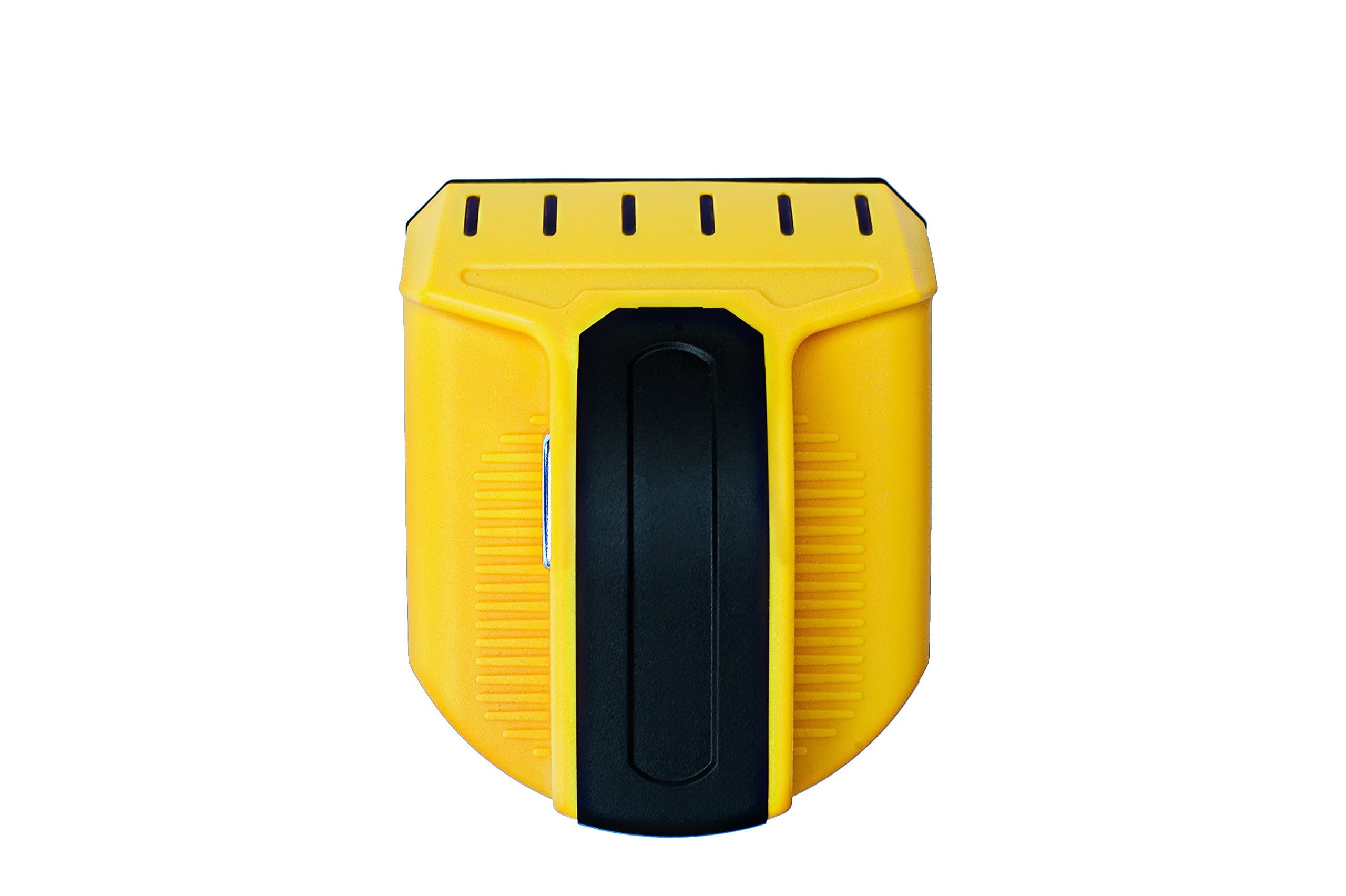
Franklin ProSensor T6 Stud Finder. Check our full review for pros, cons, and verdict.
See PricePros
- +No calibration needed, just press the button and scan
- +Shows full stud width with center and edges simultaneously
- +Works through thicker materials like soundproofing panels
- +Runs on common AAA batteries instead of 9V
- +Compact and durable enough to toss in a toolbox
- +Made in the USA
Cons
- -Does not work reliably on plaster or stucco walls
- -No live wire detection like Zircon models
- -3-inch LED display is narrower than the larger T13 model
- -Battery compartment location can be confusing at first
Our Verdict
The best stud finder for standard drywall walls. Its multi-sensor design eliminates calibration headaches and shows you the full width of the stud. Skip it if you have plaster or stucco walls.
Overview
Most stud finders work the same way: place it on the wall, hold a button to calibrate, slide slowly in one direction, and hope the beep is accurate. The Franklin ProSensor T6 throws that entire process out. It uses six sensors in a row that constantly compare readings against each other, so there is no calibration step. You press the button, put it on the wall, and the LEDs light up over the stud. That's it.
Your Best Digs tested nine stud finders and named the T6 the best overall. Pro Tool Reviews gave it their recommendation for best electronic stud finder. Reddit's r/homeimprovement and r/tools communities bring it up constantly. One user called it "like magic," and another said Franklin is "the ONLY sensor I have ever had luck with" after years of frustration with traditional models.
The T6 is the compact version of Franklin's lineup. It is the smaller sibling to the T13 (13 sensors) and the 710 (also 13 sensors, wider body). If you hang things on drywall (shelves, TVs, curtain rods, cabinets), this is the stud finder that actually works the way you always wished stud finders worked.
Key Features
The T6 has six precision sensors spread across a 10-inch sensing area, feeding into Franklin's patented Multi-Sense technology. When a sensor detects a density change behind the wall, the corresponding LED lights up. Because multiple LEDs illuminate over a stud, you can see the full width of the stud, both edges and center, at the same time. Traditional stud finders only beep at an edge, leaving you to guess where the center is.
Detection depth is rated at 1.1 inches, which covers standard 1/2-inch and 5/8-inch drywall easily. It detects both wood and metal studs. The unit runs on two AAA batteries, a welcome change from the 9V batteries that most competitors require.
There is one physical button. Press and hold it to scan. Release it to stop. There is no mode selector, no sensitivity dial, no deep scan toggle. Franklin's approach is that the deep scanning is always on.
The unit is compact. It fits in a toolbox drawer or a kitchen junk drawer. It comes with a built-in pencil slot and includes a marking pencil. Made in the USA, backed by a 1-year warranty.
Performance
On standard drywall, the T6 is remarkably accurate. Tools In Action reported 100% accuracy finding studs on drywall in their testing. They also found it correctly ignored PVC pipes, EMT conduit, and copper pipes, lighting up only over actual studs.
One YouTube reviewer demonstrated the T6 working through soundproofing panels roughly half an inch thick on top of drywall. The sensors still picked up the studs behind the extra material, something that tripped up several competing models. Multiple Amazon reviewers (4.4 stars across 3,000+ ratings) confirm it works well through thicker wall textures and textured paint.
The no-calibration design is the real selling point. With a Zircon or similar traditional stud finder, you have to place it on a spot you know is empty, hold the button to calibrate, then sweep in one direction. If you start over a stud, you get a false reading and have to start over. The T6 does not care where you start. Place it directly on top of a stud and the LEDs light up immediately. This saves a surprising amount of time, especially when you're scanning multiple walls.
Where the T6 falls short is plaster. Lath-and-plaster walls have inconsistent density throughout. The plaster itself, the lath strips, and the keys between them all register as density changes, triggering false positives. Several Amazon reviewers in older homes (pre-1960s) reported the same issue. Franklin themselves state the T6 is recommended for interior drywall only and should not be used through stucco, exterior siding, tile, wood flooring, or double layers of drywall.
Build Quality & Design
The body is yellow ABS plastic, compact and lightweight. It feels like a tool, not a toy. It is solid enough to survive drops off a ladder, which Franklin's product page specifically claims. The single-button design means there is nothing to break or get confused by.
The battery compartment is in the back of the unit, under a sliding cover. A few reviewers mention this location is not immediately obvious on first use. One Amazon reviewer spent time looking at the bottom before figuring it out. Minor complaint, but worth noting.
Battery life is generally good. Multiple long-term users report months of intermittent use on a single set of AAAs. One important caveat: Franklin recommends against rechargeable batteries, which can cause erratic behavior. Several negative reviews trace back to this issue. Once the user switched to standard alkaline AAAs, the problems went away.
The 3-inch LED display is narrower than the T13's 7-inch display. This means you see fewer LEDs light up over a stud, giving you a slightly less precise center indication. It is still accurate enough to place a screw confidently, but if you want a wider visual reference, the T13 is the step up.
Value for Money
The T6 sits in a sweet spot for the money. It costs less than most Zircon multi-scanner models and significantly less than the Franklin T13. For what it does on drywall, it is hard to argue with the price.
The main trade-off versus more expensive tools is the lack of live wire detection. The Zircon MultiScanner 740 can alert you to live AC wiring behind the wall. The T6 cannot. If you're cutting into walls for electrical work or plumbing, you will want a separate voltage detector like the Klein NCVT-1 or a Sperry DualCheck. For hanging shelves and mounting TVs, the wire detection gap is less of a concern.
Compared to the cheap single-sensor stud finders you see at every hardware store, the T6 is a meaningful upgrade in usability. The no-calibration, instant-read design alone justifies the price difference. Those cheap stud finders technically work, but the T6 works so much faster and more reliably that most people who try one never go back.
Who Should Buy This
Homeowners and DIYers with standard drywall construction (post-1970s homes). If you hang things on walls more than once a year (picture frames, shelves, curtain rods, TV mounts, towel bars), the T6 pays for itself in time saved and holes not drilled in the wrong spot.
Contractors and tradespeople who work primarily on new construction or modern remodels. Pro Tool Reviews specifically gave it a "Pro" recommendation for job site use.
Anyone who has been burned by unreliable stud finders before. The Franklin design is fundamentally different from the single-sensor approach, and the difference shows in practice.
Who Should Skip This
Owners of older homes with plaster-and-lath walls. The T6 will give you inconsistent results on plaster, and Franklin is upfront about this limitation. Look at magnetic stud finders (like the StudBuddy or a strong rare-earth magnet) or the Zircon MultiScanner 740 for plaster applications.
Anyone who needs live wire detection built into their stud finder. If you do electrical work regularly, a Zircon with AC detection or a dedicated non-contact voltage tester is a better choice. The T6 finds studs and nothing else.
If you need to scan through non-standard surfaces like tile backsplash, wood paneling, double drywall, or exterior stucco, the T6 is not designed for those applications and will give unreliable results.
Recommended Articles
Suggested Reads
Best Outdoor String Lights 2026
Our top picks for outdoor string lights, from budget solar options to heavy-duty commercial-grade strands for patios, decks, and backyards.
Best Galaxy Projectors 2026
The top galaxy and star projectors for bedrooms, from budget nebula lights to smart projectors with Alexa and Bluetooth speakers.
Best Cordless Cellular Shades 2026
The best no-drill cordless cellular shades and honeycomb blinds for renters and homeowners. Blackout and light filtering options that install in seconds without tools.
Best Solar Garden Lights 2026
Our top picks for solar garden lights, including pathway stakes, decorative globe lights, and firefly-style accents that charge during the day and glow all night.